








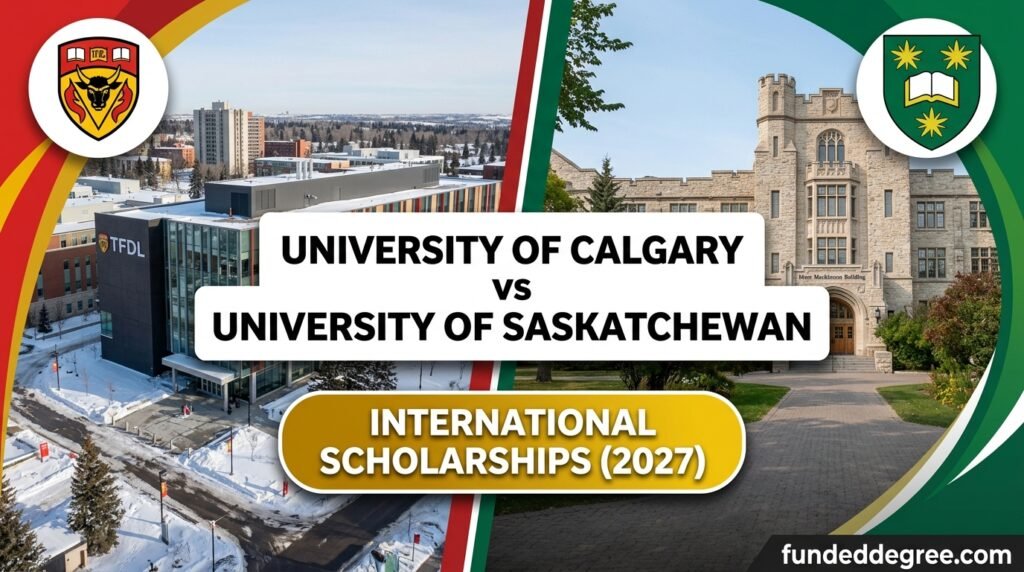
International students comparing the University of Calgary and the University of Saskatchewan for 2027 admission will find both Canadian universities offer entrance scholarships to non-Canadian applicants—but neither offers a fully funded award. Both are partial, merit-based scholarships that reduce tuition costs; they do not cover full tuition, living expenses, housing, or airfare. This guide compares the real scholarship values, deadlines, IELTS requirements, and application steps for both universities so you can plan your budget accurately before applying.
Quick Facts
| Quick Facts | University of Calgary | University of Saskatchewan |
|---|---|---|
| Deadline | March 1, 2027 (Fall 2027 intake) — scholarship considered automatically, no separate application | 2027-28 applications open Sept 25, 2026 — exact Fall closing date not yet published; check official page below before publishing a fixed date |
| Host Country | Canada (Calgary, Alberta) | Canada (Saskatoon, Saskatchewan) |
| Starting Date | Fall 2027 (September intake) | Fall 2027 (September intake) |
| Monthly Stipend | None. Tuition-only award — no living stipend. | None. Tuition-only award — no living stipend. |
Scholarship Comparison at a Glance
| University | Deadline | Official Application Link | IELTS | Financial Coverage |
|---|---|---|---|---|
| University of Calgary — International Entrance Scholarship | March 1, 2027 (Fall 2027 undergraduate application deadline) | ucalgary.ca — International Entrance Scholarship | 6.5 overall, no band below 6.0 | CAD $20,000, renewable years 2–4 (up to $80,000 total if GPA of 2.60+ maintained). Tuition contribution only — no stipend, housing, travel, or insurance. |
| University of Saskatchewan — Entrance Scholarships | 2027-28 cycle opens Sept 25, 2026. Confirm exact Fall deadline on the official page before publishing. | admissions.usask.ca — Scholarships | 6.5 overall, no band below 6.0 | Best & Brightest Entrance Scholarship: up to CAD $30,000 over 4 years ($7,500/year). IB Excellence Award: CAD $20,000, one-time, IB diploma holders only. Guaranteed Entrance Scholarship: CAD $500–$3,000. Tuition contribution only. |
Financial Coverage & Benefits
Neither university’s scholarship program covers the full cost of an international degree. Understanding the real gap between the award and actual costs is essential before you commit to either school.
University of Calgary — International Entrance Scholarship: CAD $20,000, renewable in years 2, 3, and 4 provided the recipient maintains a GPA of 2.60 or higher over a minimum of 24.00 units in the prior fall and winter terms, and continues to pay the international differential tuition fee. If renewed every year, the total value can reach CAD $80,000 across a four-year degree. The award applies only toward tuition — it does not include a monthly stipend, housing allowance, travel/airfare coverage, health insurance, or a book allowance.
University of Saskatchewan — Entrance Scholarships: USask offers several tiers rather than one flagship award. The Best and Brightest Entrance Scholarships are worth up to CAD $30,000 over four years (CAD $7,500/year), awarded based on academics, leadership, and community contribution. The International Baccalaureate (IB) Excellence Award is a one-time CAD $20,000 payment, limited to students who complete the full IB Diploma Programme. A smaller Guaranteed Entrance Scholarship (CAD $500–$3,000) is available to all admitted undergraduates, including international students, based on admission average. As with Calgary, these are tuition contributions only — no stipend, housing, travel, or insurance is included.
Reality check: International undergraduate tuition at both universities runs well above the scholarship amounts on this page — typically CAD $25,000–$40,000+ per year depending on the program, before living costs. Budget for the difference. Anyone marketing either of these awards as “fully funded” is not describing them accurately.
Eligibility Criteria
Both universities require broadly similar eligibility for their entrance scholarships:
- Non-Canadian citizen / non-Permanent Resident, paying international tuition fees
- Entering the first year of an undergraduate degree program (entrance scholarships are for new direct-entry students, not transfers or continuing students)
- Minimum IELTS 6.5 overall, with no individual band below 6.0 (or equivalent TOEFL/PTE score) — identical requirement at both universities
- Calgary: renewal requires a GPA of 2.60+ over a minimum of 24.00 units per academic year
- Saskatchewan: award tier depends on admission average; the IB Excellence Award requires completion of the full IB Diploma Programme
Required Documents Checklist
- Completed online undergraduate application (ApplyAlberta for Calgary; USask’s own application portal for Saskatchewan)
- Official high school transcripts (and any prior post-secondary transcripts, if applicable)
- Proof of English language proficiency — IELTS, TOEFL, or PTE score report
- Valid passport copy
- Non-refundable application fee (Calgary: CAD $145; Saskatchewan: CAD $90 for undergraduate applications)
- Proof of funds / financial documentation, required later for the Canadian study permit application (not for the scholarship itself)
Step-by-Step Application Process
- Confirm your program and intake: both universities process most entrance scholarships automatically upon admission — there is usually no separate scholarship application form for the awards listed above.
- Submit your undergraduate application through the official portal — ApplyAlberta for Calgary, or the USask application system for Saskatchewan — before the deadline.
- Upload official transcripts and your IELTS/TOEFL/PTE score report to your student portal.
- Pay the non-refundable application fee to complete submission.
- Wait for your admission decision. Scholarship eligibility is assessed automatically as part of the same review — no extra paperwork required for most awards.
- If awarded, check your student financial account (My UCalgary / PAWS at USask) for the scholarship confirmation and renewal conditions, and confirm the balance still owing before your tuition deadline.
- Apply for your Canadian study permit only after confirming your offer and scholarship status — do not pay tuition deposits before this is finalized.
Which One Should You Choose?
On raw scholarship value, Calgary’s award is larger: up to CAD $80,000 over four years if renewed annually, versus Saskatchewan’s roughly CAD $30,000–$50,000 maximum across its combined award tiers. If your GPA is likely to stay comfortably above 2.60 throughout your degree, Calgary’s renewable structure is the stronger financial option of the two. If you’re an IB Diploma graduate, Saskatchewan’s IB Excellence Award stacked with its Guaranteed Entrance Scholarship can close some of that gap — but neither award removes the need for a real funding plan covering the remaining tuition balance and living costs.
Neither scholarship is a substitute for a fully funded program. If your goal is genuinely zero out-of-pocket cost, look separately at funded graduate research positions (Graduate Teaching/Research Assistantships), which are far more likely to cover full tuition plus a stipend at the Master’s and PhD level, or at national scholarship programs such as Vanier CGS. For a broader look at Canadian options, see our Fully Funded Scholarship in Canada – 2026 Guide.
Sources verified directly from the University of Calgary (ucalgary.ca/registrar) and University of Saskatchewan (admissions.usask.ca) official pages. Scholarship values, deadlines, and eligibility rules are set by each university and can change — always confirm current details on the official pages linked above before applying.