




Deadline: Varies by track and year; Safeer shows the current window
Host country: USA, Canada, UK, Europe, Australia and other approved destinations
Starting date: Usually the fall intake (the Ministry plans its academic year from August)
Monthly stipend: Not published by the Ministry
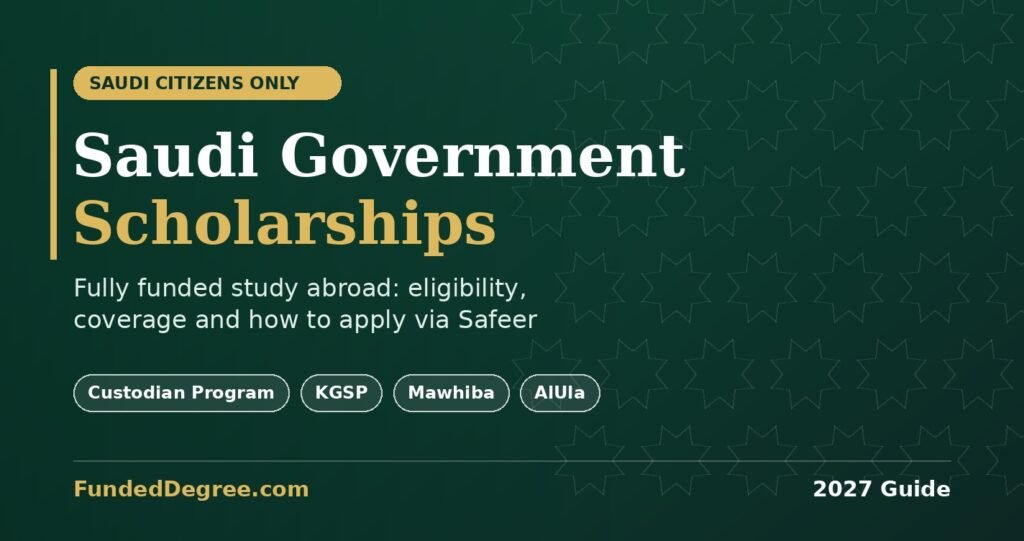
Saudi government scholarships are some of the most generous study-abroad awards anywhere, but they come with one hard rule: they’re for Saudi citizens only. If you’re a Saudi student planning a bachelor’s, master’s, PhD, or medical training abroad, this guide walks through the main programs, who qualifies, what they cover, and how to apply through the Ministry of Education’s Safeer portal.
If you’re not a Saudi national, skip to the last section. You can’t apply to any of these, and we’d rather tell you that now than waste your time.
Saudi Government Scholarships at a Glance
| Program | Who can apply | How you get in |
|---|---|---|
| Custodian of the Two Holy Mosques External Scholarship Program Ministry of Education. Bachelor’s, master’s, PhD; health fellowships. | Saudi nationals | Apply on Safeer with an unconditional admission letter |
| KAUST Gifted Student Program (KGSP) KAUST. Bachelor’s in STEM at U.S. universities. | Saudi high school seniors | Currently by invitation; interest form available |
| Mawhiba programs Mawhiba Foundation. Pre-university preparation and nomination. | Gifted Saudi students | Giftedness testing, then nomination |
| AlUla Scholarship Program Royal Commission for AlUla. Diploma, bachelor’s, postgraduate. | Saudis with an AlUla connection | Online application per intake |
1. The Custodian of the Two Holy Mosques External Scholarship Program
This is the main state program for studying abroad. The Ministry says it was approved in 2005 to send Saudi students abroad for degrees that match labor market and development needs. The Ministry launched its Safeer platform in 2010, and the program has been through several phases since.
The paths and tracks
The 2021 strategy launched by the Crown Prince named four paths: Al-Rowad (Pioneers), Research and Development, Emdad (Provider), and Wa’ed (Promising). Separately, the Ministry’s scholarship page describes a Track of Excellence and a Health Specialties track, which is what most applicants meet in practice. We couldn’t find one official page that explains exactly how the strategy’s paths map onto these tracks, so treat the names as moving targets and confirm the current structure on Safeer before you plan around one.
The Promising (Wa’ed) path is different from the others. According to a Saudi government announcement, it’s aimed at newcomers who’ll be employed with private-sector companies, combining study with on-the-job training. So it’s not simply an open application for anyone who wants to study AI or energy.
Track of Excellence: how it works
The Ministry describes it as sending Saudi students to distinguished international institutions for bachelor’s, master’s, or doctoral degrees, with the focus on fields that support Vision 2030. According to the Ministry’s page, you need to meet these conditions:
- You’re a Saudi national with good conduct.
- You hold direct, unconditional admission to an approved major at an approved institution. The program can’t be an executive program or one from a professional studies or continuing education college.
- You study full-time in the country where the institution’s main center is.
- If your previous degree is from outside the Kingdom, you have it equalized.
- Your documents are complete, and the details on your account match them exactly.
- You win a seat in the competition.
The Ministry publishes lists of approved universities and majors by year, and some majors (such as business administration, criminal justice, national security, and political science) have their own university lists. Check the lists for the cycle you’re applying to, because they change.
Per the Ministry’s FAQ, which reflects the 2022–23 cycle, seats are limited. It states 1,000 seats a year, with caps per major and per university. The competition looks at the ranking of the university, your previous academic average, whether you already hold the same or a higher degree, and whether you failed academically on an earlier scholarship. The same FAQ says there’s no age limit for this track, and that employees can apply if they attach leave permission from their employer. GPA doesn’t set a minimum eligibility bar, but it does feed into the competition. That’s where our GPA calculator comes in handy, and we’ll get to it below.
Health Specialties track
The Ministry runs a separate track for nursing, applied medical sciences, medicine, dentistry, and pharmacy. These are the key conditions listed on its page. Note that the page shows an August 2021 opening date, so confirm the current figures on Safeer.
| Track | Level | Key conditions listed |
|---|---|---|
| Nursing | Bachelor’s | Secondary school GPA of at least 85%, 70% or more on aptitude and achievement tests, age 25 or younger |
| Nursing | Master’s | Bachelor’s average of at least 2.75/4 (or 3.75/5 or 80/100), IELTS 5.5 or TOEFL iBT 46, within five years of graduating, age 30 or younger, clinical programs only |
| Applied medical sciences | Bachelor’s | Secondary school GPA of at least 90%, 80% or more on aptitude and achievement tests, IELTS 5.5 or TOEFL iBT 46, age 25 or younger |
| Medicine | Bachelor’s | Secondary school GPA of at least 95%, 85% or more on aptitude and achievement tests, IELTS 5.5 / TOEFL iBT 46, age 25 or younger |
| Medicine, dentistry | Fellowship | Minimum IELTS 6 (or equivalent), a recognized accredited program, and the Saudi Commission for Health Specialties classification and registration exam |
Destination countries differ by specialty. For nursing, the Ministry’s page lists the USA, Canada, Britain, Ireland, New Zealand, Australia, and France. Applied medical sciences adds Germany. Applicants for the health track also need to be medically fit.
2. KAUST Gifted Student Program (KGSP)
KAUST created KGSP in 2008 for talented Saudi high school graduates in STEM fields. Students earn a bachelor’s degree at a top U.S. university, then apply to a KAUST graduate program. KAUST describes it as fully funded. Most students start with a Foundation Year, though those who already have full admission to an approved university go straight into undergraduate study.
The big thing to know is that selection is extremely competitive and, according to the program’s site, currently by invitation only. Students who haven’t been nominated can register interest through the KGSP Interest Form on KAUST’s program page. KAUST’s 18th cohort held its pre-departure orientation in June 2026, and the program says it has sent more than 750 students abroad since it began. See the official KGSP site for how to get on the radar.
3. Mawhiba: Preparation and Nomination, Not a Standalone Application
Mawhiba (the King Abdulaziz and His Companions Foundation for Giftedness and Creativity) works alongside the Ministry to prepare gifted students for top international universities. Its Excellence Program is a one-year training program that starts in the second semester of junior year in high school and runs until the student receives a university acceptance, including SAT preparation, according to Arab News.
Mawhiba’s enrichment programs also feed students into the Ministry’s scholarships for the gifted, and it nominates strong students for KAUST and Aramco scholarships. The takeaway is that you usually enter through giftedness testing and Mawhiba’s programs first, then get nominated. You don’t just fill out a form and receive a scholarship.
4. Royal Commission for AlUla (RCU) Scholarship Program
RCU sends students from the AlUla governorate abroad to build local expertise in fields like tourism and hospitality, agriculture, archaeology, heritage, architecture, and urban planning. Past intakes have placed students in the US, the UK, France, and Australia. We found no confirmation of Canada as a destination.
Eligibility is tied to AlUla. For a recent intake, applicants had to be Saudi nationals who were born in AlUla, had a parent born there, or had studied at least six years in the AlUla area. Because the rules and intake years change, check the RCU website for the current call. Some tracks also start with language training in the host country before the degree itself begins.
What Do the Scholarships Cover?
Government scholarships like these typically pay for tuition, a living allowance, health insurance, and travel. Here’s what we could confirm, and what we couldn’t.
| Confirmed on the Ministry’s page | Financial guarantee letters to universities, an embassy introduction letter for visas, criminal record certificates where a country requires them, and travel tickets for the student and companions |
| Reported by third-party guides | Full tuition, living costs, health insurance, and return flights for the student |
| Not published (verify first) | Monthly stipend amounts, dependent allowances, dental coverage, and coverage for an accompanying guardian |
If a blog quotes exact stipend or dependent figures without linking an official Ministry source, don’t plan your finances around it. Ask your cultural mission, or use the Safeer inquiry service.
How to Apply on Safeer (Track of Excellence)
- Check your eligibility against the Ministry’s conditions above, including nationality, degree equivalency, and full-time study.
- Pick a major and universities from the approved lists for your cycle. Apply to several, since seats fill up.
- Get an official unconditional admission letter that clearly shows your major, the start date, and the university’s name.
- Prepare your documents: national ID, valid passport, national address, previous qualification certificate and equivalency (if from abroad), and the admission letter. If family will travel with you, add their ID or family record and passports.
- Apply on Safeer. A submitted application can’t be edited. To change the major, university, degree, or start date, you have to submit a new one, so double-check before you click send.
- Wait for the competition results, which are sent to your Safeer account after the window closes.
- Complete post-nomination services: the embassy letter, criminal record certificate if needed, the scholarship decision, and travel tickets.
- Start your studies and register through Safeer 2, where you’ll also request financial guarantee letters. You must start studying within a month of the start date in your scholarship decision.
On timing, the Ministry has opened and closed the Excellence window each year. For example, the 2023/24 window ran from December 4, 2022 to May 5, 2023. We couldn’t confirm the current window, so look it up on Safeer rather than relying on any date you read here or on another blog.
How to Improve Your Chances
- Aim for a higher-ranked university. The Ministry lists university ranking as a competition criterion.
- Know your academic average. Your previous qualification’s average is part of the ranking, and the health track has hard cutoffs. Convert your grades to the right scale with our grading scale.
- Don’t hold the same degree already. Applicants who already have the same or a higher degree rank lower in the competition.
- Apply early. Seats are limited per major and per university, and applications are processed until they’re full.
- Write a strong admissions essay. The scholarship needs admission first. Our statement of purpose guide can help with that part.
Frequently Asked Questions
Can non-Saudis apply for these scholarships?
No. Each program on this page requires Saudi nationality.
Is there an age limit?
The Ministry’s FAQ says the Track of Excellence has no age limit. The health track has limits, such as 25 for most bachelor’s programs and 30 for nursing and applied sciences master’s.
Do I need IELTS?
For the Track of Excellence, you need to meet your university’s English requirements. The health track lists IELTS or TOEFL minimums, such as IELTS 5.5 for several programs and 6 for fellowships.
Can my family come with me?
The Ministry’s process lets you register companions and request travel tickets for them. The exact allowances aren’t published on that page, so ask through Safeer.
Does my GPA matter?
For the Track of Excellence, there’s no minimum, but your previous average counts in the competition. For the health track, the listed cutoffs are strict.
Not a Saudi Citizen?
These programs are closed to you, but plenty of others aren’t. Browse our fully funded scholarships in the USA, check the live deadlines tracker, or try the scholarship finder. UAE nationals can read our guide to the Fulbright program for UAE students, another citizens-only award.
Two Free Tools to Use Before You Apply
Most scholarships, including Saudi ones, weigh your academic record, and grading systems differ a lot between countries. Two tools on Funded Degree can save you time:
- GPA Calculator: work out your GPA from your course grades and credits so you know where you stand.
- Grading Scale: see how percentages, letter grades, and GPA scales line up, which helps when you’re converting between Saudi, U.S., and European systems.