



I’ve read a lot of Statements of Purpose over the years. Hundreds, honestly, from students applying to DAAD, Chevening, Fulbright, KAUST, Erasmus Mundus, you name it. And here’s what still surprises me: most of them are good on paper (great grades, real experience) and still get rejected because the SOP reads like everyone else’s.
That’s the problem I built this free mini-course to fix.
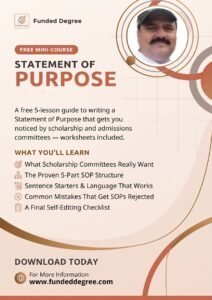
It’s called “How to Write a Winning Statement of Purpose to Get a Fully Funded Scholarship,” and it’s a five-lesson PDF guide you can get by email from Funded Degree, free, with no payment needed.
Get the free PDF guide
Enter your email and we’ll send the full five-lesson guide, with worksheets, straight to your inbox. It’s free.
No spam. Only the guide and occasional scholarship deadline alerts. Unsubscribe anytime.
Before you write a word: read the scholarship’s own instructions
Different scholarships ask for different documents. Some call it a statement of purpose, others a motivation letter, personal statement, or study objective, and each has its own prompt and word limit. Chevening, for example, asks for several short essays rather than one long statement. Whatever you write, follow the exact prompt and limit on the official application page, and use a guide like this one to shape your answers, not to replace them.
Here’s what’s actually inside.
1. Lesson one deals with something most applicants get wrong before they even start typing:
They don’t know what the committee is looking for. Spoiler, it’s not your life story. It’s fit and evidence. I walk through the three questions every reviewer is silently asking as they read (why this field, why you, why this program) and show you the difference between an SOP that describes a quality and one that proves it.
2. Lesson two is the structure:
The actual five-part skeleton that works across almost every scholarship I’ve reviewed, from a 500-word Chevening essay to a full-page university statement. Hook, background, motivation, program fit, closing. I give you the approximate word count for each part and a worksheet to outline yours before you write a single paragraph.
3. Lesson three is language:
Real sentence starters for your opening, your motivation section, and your closing. And a list of phrases to delete on sight (“since I was a child,” “I am very passionate,” that kind of thing). If you’ve ever stared at a blank page not knowing how to start, this lesson alone is worth the download.
4. Lesson four covers the mistakes that get SOPs rejected.
generic praise for the university, a statement that’s really just your CV in paragraph form, and no clear plan for after graduation. Small fixes, big impact.
5. Lesson five is a self-editing checklist.
The kind reviewers actually use. Content check, technical check, final read. By the time you get there, you’ll have a real first draft, not just notes.
I wrote this because I got tired of seeing capable students lose scholarships over a document that’s genuinely learnable. It’s not about being a naturally gifted writer. It’s about knowing what to say and how to say it, and most students have simply never been shown.
Once you have it, work through it lesson by lesson and use the worksheets. Don’t just read it passively; actually fill it in. That’s where the real difference happens.
Questions while you’re working through it? Message us on WhatsApp at +92 300 4444800, or join our WhatsApp channel for scholarship alerts and updates as we add more guides to this series (recommendation letters and interview prep are coming next). Subscribe to my blog and newsletter to get alerts on time.