






The Erasmus Mundus MARIHE Scholarship 2027 (Fully Funded): Here’s Everything You Actually Need to Know
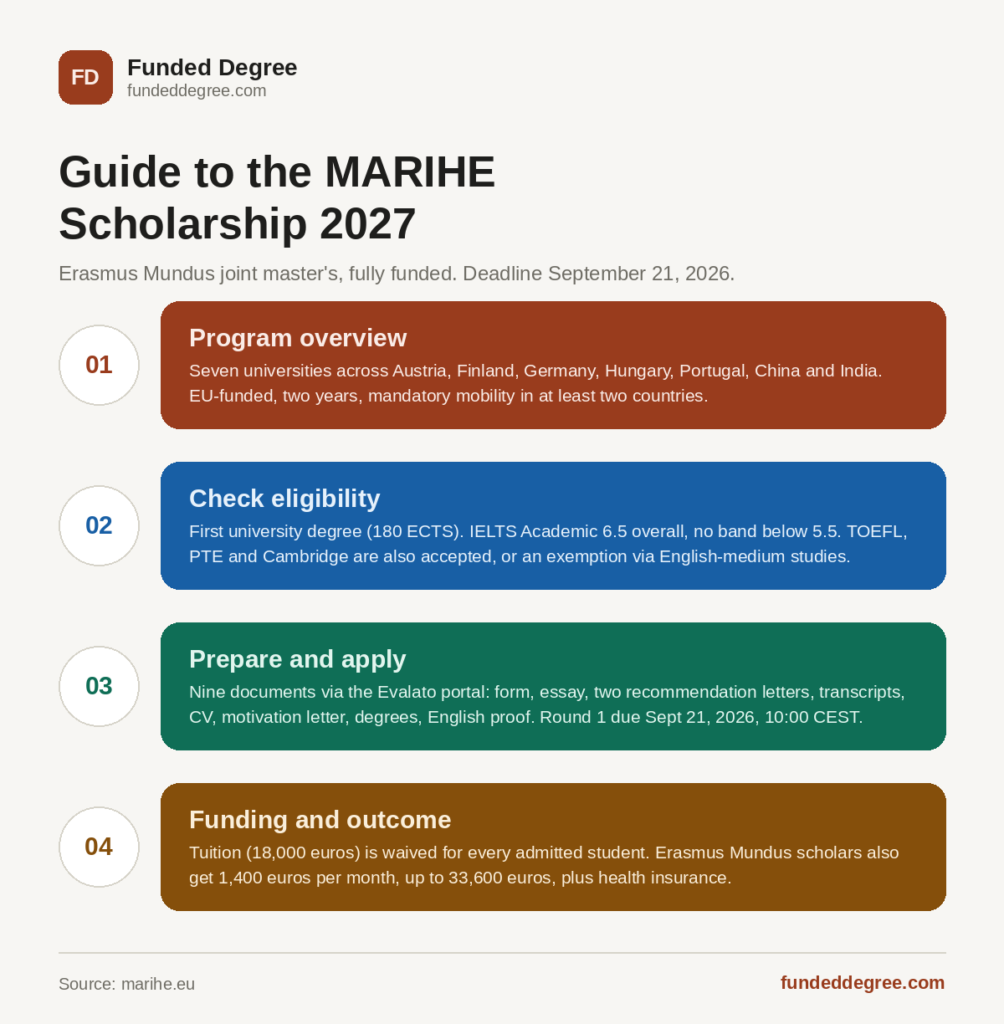
If you’ve ever wanted a master’s degree that doesn’t just talk about international higher education but actually forces you to live it across four different countries, if you play your specialization right, MARIHE is worth your attention this week. Applications for the 2027 intake close on September 21, 2026, at 10:00 a.m. CEST. That’s not a typo. You have days, not months.
MARIHE stands for Master’s in Research and Innovation in Higher Education. It’s one of the Erasmus Mundus Joint Master’s programs, which means the European Union funds it directly through the Erasmus+ program, and it comes with a scholarship structure that’s genuinely rare: tuition is waived for every single admitted student, scholarship or not. I’ll get into why that matters in a minute, because it changes how you should think about your odds here.
What MARIHE Actually Is
Seven universities run this program together, and you don’t pick just one; you move between them.
- University for Continuing Education Krems, Austria (this is the coordinating institution)
- Tampere University, Finland
- Osnabrück University of Applied Sciences, Germany
- Eötvös Loránd University, Hungary
- University of Aveiro, Portugal
- Beijing Normal University, China
- Thapar Institute of Engineering and Technology, India
Every student starts the same way: first semester at Krems in Austria, second semester at Tampere in Finland. That part’s fixed. From there, things branch. Your third semester is a specialization track paired with a mandatory internship, and depending on which specialization you choose, you could end up in Germany, Hungary, Portugal, China, or India, or stay put in Austria or Finland. Your fourth semester, where you write your thesis, follows a similar logic: you pick from whichever partner institutions fit your specialization.
There’s a rule buried in the eligibility criteria that trips people up, so let me flag it now: if you’re a resident of Austria or Finland, you can’t choose the Krems or Tampere specialization track for your third and fourth semesters. The EU funding requires at least two study periods of genuine mobility in two different countries, one of which has to be an EU member state, each worth a minimum of 30 ECTS. So if you already live in one of the first two host countries, the program pushes you further afield. Honestly? That’s probably the point.
The whole degree runs two years, four semesters, full-time. Classes start in September 2027 at Krems.
The Money: What’s Actually Covered
Here’s the detail that a lot of scholarship roundups gloss over, and it’s the single most important thing to understand about MARIHE: tuition is free for everyone who gets in.
The program costs €18,000 for the full four semesters. If you’re awarded the Erasmus Mundus scholarship, that amount is paid on your behalf. If you’re admitted without the scholarship, the consortium waives it anyway. Either way, you’re not paying tuition. What you’re actually competing for, when you apply for the Erasmus Mundus scholarship specifically, is the money that covers everything tuition doesn’t, and that’s where the real financial pressure lives for most applicants, because living costs, visas, and flights across four countries add up fast.
If you win the Erasmus Mundus scholarship, here’s what it gives you:
The scholarship pays €1,400 per month for the length of your studies, calculated on a monthly basis (partial months get prorated at 1/30 per day). Over the full 24-month program, that maxes out at €33,600. That figure is meant to cover accommodation, general living expenses, visa costs, travel between your host countries, and costs tied to your study and research activities; it’s not narrowly restricted to rent.
One practical catch worth knowing before you get your hopes up too far: your first payment doesn’t land until after you physically arrive in Krems. Anything you spend before that visa fee, document legalization, your flight over, or your first month’s deposit on an apartment — comes out of your own pocket first. You’ll need a SEPA bank account to receive the funds too, which is something to sort out early if you’re coming from outside the eurozone.
All students, scholarship or not, also get health and accident insurance that meets the EU’s requirements for Erasmus Mundus students. This covers accidents and sudden illness, though it won’t touch pre-existing conditions, so if you have an ongoing health issue, budget for supplemental coverage on your own.
There are two smaller funding streams worth knowing about if you don’t land the main scholarship. MARIHE runs a special award, actually two, named the “Dr. Qiang Liu” and “Prof. Gábor Halász” scholarships, after two people who helped build the program aimed at students from disadvantaged backgrounds or who are first in their family to pursue higher education. It’s capped at €6,000 as a contribution toward travel and visa costs, reimbursed after you’ve already incurred them, and only available to students admitted without the Erasmus Mundus scholarship. Separately, non-scholarship students can apply for Erasmus+ Student Mobility funding once they’ve started the program, which runs €300 to €400 a month depending on where you’re studying, for up to 12 months. It doesn’t cover every semester or every location; the China placement at Beijing Normal University, for instance, isn’t eligible for this particular funding stream.
Who Can Apply
The academic bar is straightforward: you need a first university degree, a bachelor’s or equivalent representing at least three years of full-time study, or 180 ECTS credits if your country uses that system. MARIHE doesn’t care what your degree is in. That’s genuinely unusual for a program this specific, and it means a background in engineering, literature, or public health is just as valid a starting point as one in education policy.
One nuance that catches people off guard: MARIHE only looks at your first completed tertiary degree. If you’ve already got a bachelor’s and a master’s, they don’t average the two or consider your master’s; instead, the bachelor’s is what counts, full stop. Work experience doesn’t substitute for missing academic credentials either, though it does strengthen your application narrative if it’s relevant to higher education work.
Then there’s English proficiency, and this is where I’d tell a student sitting across from me, “Don’t leave this until August.” MARIHE only accepts five test certificates, and the language requirements changed slightly this year, so double-check which version applies to your test date:
- IELTS Academic: 6.5 overall, no band below 5.5
- TOEFL iBT: 92 out of 120 (for tests taken before January 21, 2026) or 4.5 out of 6 with no section below 4 (for tests taken on or after January 21, 2026)
- PTE Academic: 62 out of 90
- Cambridge C1 Advanced: grade C
- Cambridge C2 Proficiency: grade C1
Duolingo doesn’t count. Neither does a letter from your university saying you’re proficient. MARIHE has been explicit that there are no exceptions here, and applications that show up without a valid certificate or with an expired one, since most of these tests are only valid for two years, get rejected on formal grounds before anyone even reads your motivation letter.
You might be exempt from testing altogether if you completed a full bachelor’s, master’s, or doctoral degree taught entirely in English and the institution awarding it was physically located in a specific list of countries: the EU/EEA states, the UK, the US, Canada, Australia, and New Zealand, and a longer list that includes places like India, Kenya, Nigeria, the Philippines, and Singapore. The same applies if you finished upper secondary school in English in a narrower set of countries (EU/EEA, UK, US, Canada, Australia, New Zealand, Switzerland). Here’s the trap: having English-medium instruction isn’t enough on its own if the school isn’t located in one of those countries. A branch campus doesn’t count either; it has to be the actual home campus. Read that list twice before assuming you qualify.
How the Application Actually Works
MARIHE runs a two-round process, and it’s worth understanding both rounds before you start, because they ask for different things at different times.
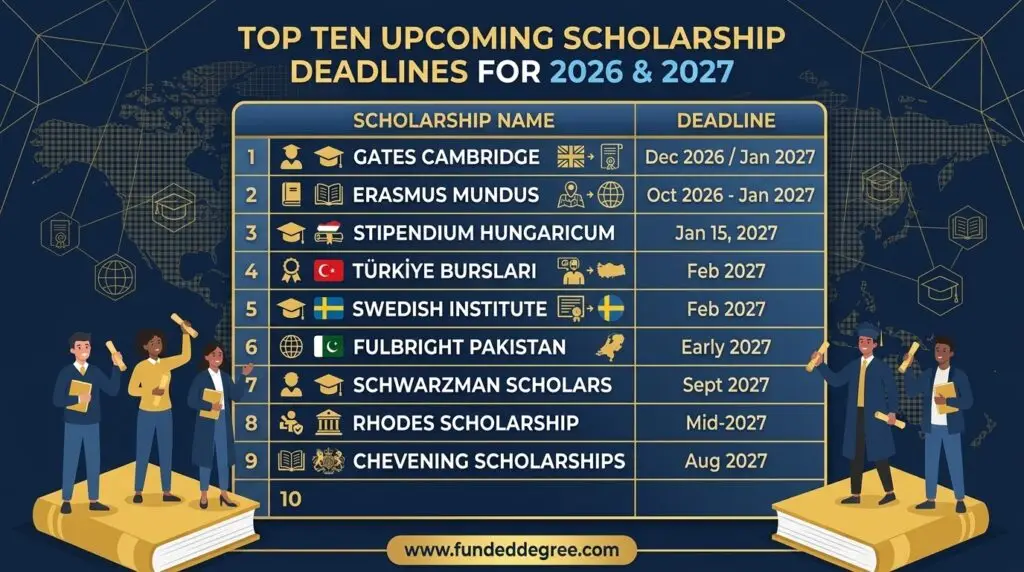
Round 1 is where nearly everyone drops off. You submit nine documents through MARIHE’s online portal (they use a platform called Evalato), including the application form itself, an essay, two letters of recommendation, academic transcripts, a copy of your passport, a CV in Europass format, a letter of motivation, your degree certificates, and proof of English proficiency. This is due September 21, 2026, at 10:00 a.m. CEST. Two independent reviewers score every eligible application against MARIHE’s published assessment criteria.
If you make the cut, you move to Round 2, which is lighter: a single video submission, due December 11, 2026, at 10:00 a.m. CET. The same two reviewers who scored your written materials also assess the video and add to your overall score.
From there, MARIHE ranks everyone and sorts applicants into one of five outcomes: the Erasmus Mundus scholarship main list, its reserve list, the tuition-fee-only main list, its reserve list, or rejection. Landing on a main list gets you an offer, but selection isn’t the same as admission. You still have to complete Krems’s formal enrollment process, including legalizing your degree certificate if required, before your place is locked in.
Apply through MARIHE’s official portal at evalato.com (linked directly from marihe.eu), not through any third-party site claiming to process applications on the program’s behalf. And before you submit anything, actually read the MARIHE Guideline for Applicants document on their site. It’s dense, but it answers most of the procedural questions people end up emailing the secretariat about anyway, and MARIHE explicitly asks applicants to check it before reaching out.
Is It Worth Applying For?
If you’re set on a career in higher education policy, research administration, or international education management, MARIHE gives you something few programs can: direct institutional experience in multiple national systems, not just coursework about them. You’ll sit through Austrian bureaucracy, Finnish academic culture, and whichever third and fourth environments you land in, and that’s a different kind of learning than reading case studies about comparative higher education from one campus.
The trade-off is real, though. Moving across three or four countries in two years is logistically demanding: visas, housing, insurance paperwork, saying goodbye to friends you just made, repeatedly. If stability matters more to you right now than breadth, a single-location master’s might serve you better, and Germany’s DAAD-funded programs are a good place to start looking. But if you’re the kind of student who gets energized rather than exhausted by that kind of movement, and your English scores and degree are in order, get your documents together this week. You don’t have much runway left.